
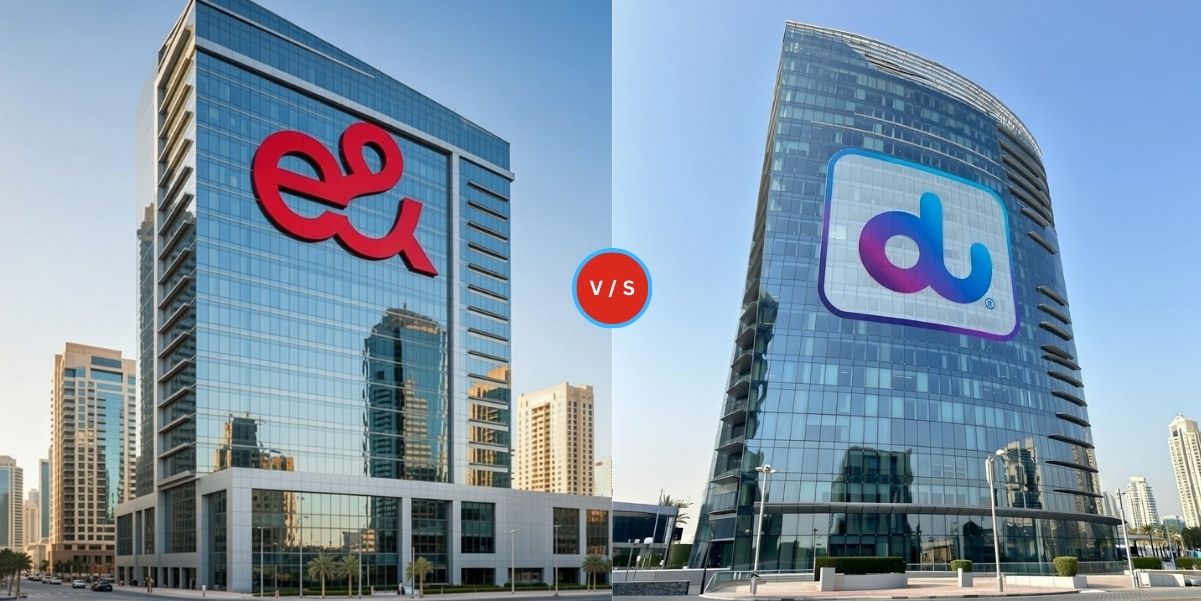
Why Are There Only Two Major Telecom Companies in the UAE?
Understanding the Etisalat (e&) and du Duopoly
The United Arab Emirates is one of the world’s most digitally advanced nations, boasting near-universal mobile penetration, extensive 5G coverage, and some of the fastest internet speeds globally. Yet, unlike many large economies that host multiple telecom operators, the UAE has only two major telecommunications providers: e& (formerly Etisalat) and du.
This is not accidental. It is the result of strategic government planning, regulatory control, national security considerations, and economic efficiency.
Let’s break it down step by step.
1. Telecom Is a Strategic National Infrastructure in the UAE
In the UAE, telecommunications is viewed not merely as a commercial service, but as critical national infrastructure, similar to:
- • Electricity
- • Water
- • Aviation
- • Ports
- • Defense-related systems
Because telecom networks carry:
- • Government communications
- • Financial transactions
- • Military and security data
- • Emergency services
…the UAE government maintains tight control over who can build, operate, and manage these networks.
Allowing unlimited private or foreign telecom players would dilute oversight and raise national security risks.
2. Etisalat Was Created as a State Monopoly (1976–2006)
Etisalat was founded in 1976 as a fully government-owned entity with a clear mandate: to build and manage the UAE’s telecom infrastructure from the ground up.
For nearly three decades, Etisalat operated as:
- • The sole telecom provider in the UAE
- • A state-backed monopoly
- • The backbone of national digital development
This monopoly model allowed the UAE to:
- • Rapidly deploy nationwide connectivity
- • Maintain uniform network standards
- • Avoid fragmented infrastructure
Competition was intentionally avoided during this period to ensure speed, reliability, and centralized control.
3. du Was Introduced in 2006 – Controlled Competition Begins
By the early 2000s, the UAE witnessed:
- • Rapid population growth
- • Explosive mobile phone adoption
- • Increasing internet demand
To avoid stagnation, the government introduced a second operator: du, launched in 2006.
However, this was not open-market liberalization. Instead, the UAE adopted a managed duopoly model:
- • Enough competition to improve service quality
- • Enough pricing pressure to benefit consumers
- • Not enough fragmentation to weaken infrastructure
du was designed as a complement, not a destabilizing rival, to Etisalat.
4. Strong Regulation by the TDRA
The UAE’s telecom sector is regulated by the Telecommunications and Digital Government Regulatory Authority (TDRA), which strictly controls:
- • Licensing approvals
- • Spectrum allocation
- • Pricing frameworks
- • Service quality standards
Spectrum is limited, expensive, and strategically sensitive. Issuing multiple licenses would:
- • Reduce efficiency
- • Increase regulatory complexity
- • Weaken network reliability
As a result, TDRA deliberately restricts the number of full telecom operators.
5. Small Market Size and High Infrastructure Costs
Despite its global influence, the UAE has:
- • A relatively small population
- • Compact geographic coverage
- • Extremely high service expectations
Telecom networks require billions of dollars in upfront investment and constant upgrades (4G, 5G, fiber, data centers).
Allowing too many operators would:
- • Duplicate networks unnecessarily
- • Reduce profitability
- • Lower long-term investment quality
Two operators strike the ideal balance between competition and sustainability.
6. Protecting National Revenue and Strategic Interests
Both e& and du are major contributors to:
- • Government revenue
- • Employment generation
- • National digital transformation
e&, in particular, operates in 16+ countries and acts as a global technology ambassador for the UAE.
The UAE prioritizes strong national champions over fragmented foreign dominance.
7. Security, Surveillance, and Data Sovereignty
Telecom operators in the UAE must comply with:
- • Lawful interception laws
- • Data localization requirements
- • National cybersecurity frameworks
Managing these obligations across two trusted operators is significantly easier and safer than across many independent players.
Fewer operators mean stronger data control and faster enforcement.
8. Duopoly Does Not Mean Lack of Innovation
Despite having only two telecom operators, the UAE consistently ranks among:
- • Global leaders in internet speed
- • Early adopters of 5G technology
- • Pioneers in smart city infrastructure
This proves that controlled competition can outperform overcrowded markets when backed by strong regulation.
Final Conclusion
The presence of only two major telecom operators in the UAE is the result of a deliberate, long-term national strategy.
Stability, security, quality, and sustainability were prioritized over unrestricted competition — and by global standards, the approach has been highly successful.
The UAE telecom model demonstrates that fewer operators, when properly regulated, can deliver world-class digital infrastructure.